
UGC video ads are not simply videos of someone holding a product and saying, “I love this.”
Effective UGC is a combination of human storytelling, product understanding, audience psychology, strong editing, and platform-native creative.
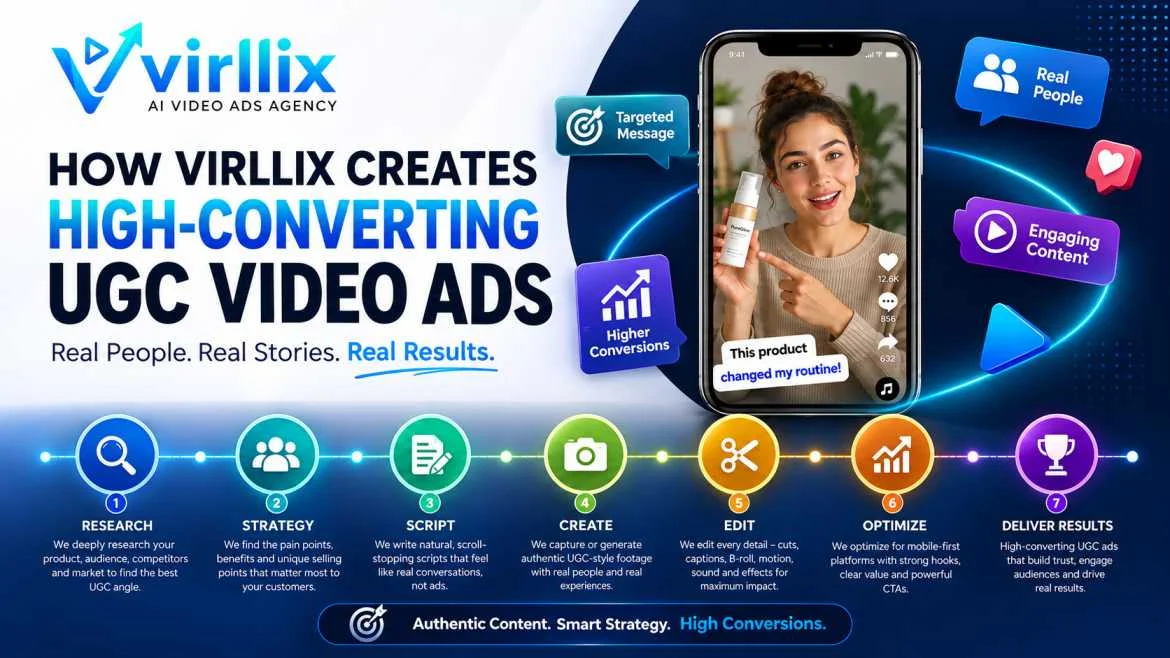
At Virllix, we approach every UGC project as a creative performance asset. Before creating the video, we research the client’s product or service, understand the target customer, identify the strongest selling points, and then turn that research into a natural-looking video designed for platforms such as TikTok, Instagram Reels, and YouTube Shorts.
Research from TikTok for Business also emphasizes that effective short-form creative should feel native to the platform, capture attention quickly, communicate a relevant problem and solution, and make the next action clear.
1. We Start With the Client — Not the Camera
The first step is understanding exactly what the client is selling.
Virllix researches:
- The product or service
- Website and landing pages
- Product features
- Customer benefits
- Pricing and offers
- Target audience
- Customer pain points
- Frequently asked questions
- Reviews and testimonials supplied by the client
- Competitors
- Existing advertisements
- Brand tone and visual identity
- Existing social-media content
We don’t want the creator to simply list features.
We want to discover the answer to a more important question:
“Why would someone actually care about this product?”
That answer becomes the foundation of the UGC concept.
2. We Break the Product Down — Feature by Feature
A product can contain dozens of features, but an advertisement cannot explain everything.
Virllix breaks the product into individual components and asks:
What is the feature?
↓
What problem does it solve?
↓
Why does that matter to the customer?
↓
How can we show it instead of simply talking about it?
For example:
Feature: Waterproof material
Customer benefit: Keeps belongings protected from rain
Visual idea: Creator demonstrates the product during a rainy commute.
This “show, don’t just tell” approach is particularly useful for UGC because viewers can visualize how the product fits into their own life. TikTok’s own creative guidance similarly recommends product demonstrations and showing products in real-life use cases.
3. Audience Research Comes Before the Script
The same product can require completely different UGC depending on the audience.
Virllix identifies:
- Who the customer is
- What problem they experience
- What they care about
- What objections might stop them buying
- What type of language feels natural to them
- What benefits are most relevant to them
For example, a skincare advertisement might focus on a personal routine and visible product experience.
A SaaS product might use a “this saved me hours every week” storyline.
A fashion brand might use a try-on or styling format.
The product stays the same.
The story changes according to the audience.
4. Competitor & Creative Research
Before producing the UGC ad, Virllix studies the competitive landscape.
We examine:
- Competitor hooks
- Video structures
- Creator styles
- Product demonstrations
- Testimonials
- Offers
- CTAs
- Editing patterns
- Common messaging
- Creative gaps
TikTok recommends researching competitors, customer reviews, and successful creative examples before building advertising content.
The goal is not to copy another brand.
Instead, we ask:
“What is everyone else saying — and what can we communicate differently?”
This gives the UGC ad its own creative angle.
5. We Find the Strongest UGC Angle
After research, Virllix selects the most appropriate storytelling format.
Possible formats include:
Problem → Solution
“I had this problem until I found this…”
Product Demonstration
“Here’s exactly how I use it…”
Unboxing
“Let’s see what just arrived…”
Testimonial
“I’ve been using this for a few weeks and here’s what I noticed…”
Before → After
“This was my situation before using it…”
Tutorial
“Here’s how I use this in three simple steps…”
Comparison
“I tried both — here’s what I noticed…”
Story / Experience
“I didn’t expect this to make such a difference…”
These formats align with established short-form creative patterns such as problem/solution, product demonstration, unboxing, tips, and testimonials.
6. The Hook Is Designed First
The first few seconds have one job:
Stop the scroll.
Instead of beginning with a long introduction or logo animation, Virllix develops a hook around the audience’s problem, curiosity, desire, or experience.
Examples:
Problem Hook:
“Why does my skin always feel dry after cleansing?”
Curiosity Hook:
“I honestly didn’t expect this to work…”
Result Hook:
“This completely changed my morning routine.”
Demonstration Hook:
“Watch what happens when I use this…”
Comparison Hook:
“I tested both — here’s the difference.”
TikTok’s current creative guidance specifically recommends strong hooks in the opening seconds and early communication of the product’s value proposition.
7. We Build a Natural UGC Script
The script shouldn’t sound like a corporate commercial.
Instead of:
“Our revolutionary product provides innovative solutions for modern consumers.”
A UGC-style approach could sound more like:
“I’ve been looking for something that actually solves this problem, and I finally found it.”
The objective is to make the dialogue feel conversational, believable, and easy to understand.
The script normally follows a simple structure:
HOOK → PROBLEM → EXPERIENCE → PRODUCT → BENEFITS → PROOF → CTA
Not every advertisement needs every element, but the structure gives the creator a clear story to follow.
8. We Plan Every Shot Before Editing
Virllix doesn’t simply generate a talking-head video and add captions afterward.
Each section is planned.
For example:
0–3 sec: Hook / attention shot
3–7 sec: Problem
7–12 sec: Product introduction
12–18 sec: Product demonstration
18–23 sec: Benefits
23–27 sec: Social proof / result
27–30 sec: CTA
The exact duration changes depending on the campaign.
The important principle is:
Every shot should have a reason to exist.
9. Product Integration Is Carefully Controlled
One of the biggest problems with product-focused AI or UGC production can be inconsistent product presentation.
Virllix pays attention to:
- Product appearance
- Packaging
- Logo
- Brand name
- Product positioning
- Hands and interactions
- Demonstration sequence
- On-screen claims
- Visual consistency
The product should feel like part of the creator’s story rather than something randomly inserted into the video.
10. Editing Happens Layer by Layer
This is where Virllix goes deep into the creative.
Instead of treating the video as one single file, we work through individual layers.
Layer 1 — Performance
We refine the creator’s delivery, pacing, expressions, pauses, and overall flow.
Layer 2 — Cuts
Unnecessary pauses and repetitive sections are removed to maintain momentum.
Layer 3 — B-Roll
Relevant product shots, demonstrations, lifestyle footage, screenshots, or supporting visuals are added.
Layer 4 — Captions
Important dialogue is converted into readable on-screen text so the message remains understandable even without relying entirely on audio. TikTok also recommends captions and on-screen text for accessibility and sound-off viewing.
Layer 5 — Motion
Subtle zooms, punch-ins, transitions, highlights, and movement are used where they improve attention.
Layer 6 — Sound
Music, voice, sound effects, and transitions are balanced and synchronized.
Layer 7 — Branding
Brand elements are introduced without making the video feel like a traditional corporate commercial.
11. We Edit for Attention — Not Just Appearance
A beautiful video isn’t automatically an effective advertisement.
Virllix checks the pacing of every section:
Is this shot too long?
Is the message clear?
Does the product appear at the right moment?
Is the benefit obvious?
Is anything distracting the viewer?
Does the video still make sense without sound?
Is the CTA easy to understand?
TikTok’s creative guidance recommends testing different hooks, captions, formats, and creative approaches rather than assuming one version will work for every audience.
12. We Create Multiple Creative Angles
Instead of depending on one idea, Virllix can develop multiple UGC concepts from the same research.
For example:
Version A: Problem/Solution
Version B: Product Demonstration
Version C: Testimonial
Version D: Before/After
Version E: Founder/Creator Story
This gives the client more creative variations to test.
A winning hook, opening shot, or CTA can then inform future creative iterations.
13. Final Quality Control
Before delivery, Virllix reviews the complete advertisement.
We check:
- Script accuracy
- Product details
- Brand name
- Visual consistency
- Captions
- Timing
- Audio quality
- Lip-sync where applicable
- Product visibility
- CTA
- Mobile readability
- Overall storytelling
The goal is to make the final creative feel natural enough to watch as content and structured enough to function as an advertisement.
14. The Virllix UGC Ad Philosophy
We don’t believe UGC should simply look “low budget.”
It should look human, relatable, platform-native, and intentional.
The production can be polished while still retaining the characteristics that make creator-style content engaging: a natural delivery, real-life context, quick storytelling, visible product use, and authentic-looking communication.
TikTok has highlighted authenticity, entertainment, and creator-style storytelling as important elements in connecting creator content with the purchase journey.
The Complete Virllix UGC Video Ad Process
CLIENT PRODUCT / SERVICE
          ↓
   DEEP PRODUCT RESEARCH
          ↓
   AUDIENCE RESEARCH
          ↓
COMPETITOR + CREATIVE RESEARCH
          ↓
 FIND PAIN POINT + USP
          ↓
    CHOOSE UGC ANGLE
          ↓
   WRITE THE HOOK
          ↓
  SCRIPT + SHOT PLANNING
          ↓
   CREATE UGC FOOTAGE
          ↓
 PRODUCT + B-ROLL INTEGRATION
          ↓
   DEEP EDITING
          ↓
CAPTIONS + MOTION + SOUND
          ↓
   CTA + BRANDING
          ↓
  QUALITY CONTROL
          ↓
     FINAL UGC AD
          ↓
   TEST → LEARN → ITERATE
From Product Research to UGC Ad
The Virllix process can be summarized in one simple formula:
Research → Understand → Strategize → Script → Create → Edit → Test → Improve
The camera is only one part of a UGC advertisement.
The real work happens before and after the recording — understanding the customer, finding the right message, choosing the right creative angle, controlling every shot, and editing every detail around a clear advertising objective.
Virllix turns product information into human-centered UGC stories designed to earn attention, communicate value, and encourage actions